
Best Desert Plants for Scottsdale Yards | 2026 Local Guide
Most plant guides for Arizona are written for the state broadly. Scottsdale sits in Hardiness Zone 9b. Summer highs consistently push past 110 degrees, monsoon storms arrive between June 15 and September 30, and the soil on most residential lots contains a caliche layer that blocks drainage. Generic “desert plant” lists often miss all three of those factors.
This guide covers what actually works in Scottsdale yards. organized by plant type, with notes on mature size, caliche tolerance, and where each plant fits in a real landscape plan. Plant names that appear on the Arizona Municipal Water Users Association (AMWUA) approved list are noted, since many HOA communities in Scottsdale reference that list for front yard approvals.
Quick Reference: Desert Plants for Scottsdale Yards
| Plant | Type | Mature Size | Water Needs | Best Use | Caliche Tolerance |
|---|---|---|---|---|---|
| Desert Museum Palo Verde | Tree | 20 to 30 ft | Low once established | Shade, focal point | Good |
| Chilean Mesquite | Tree | 20 to 30 ft | Low once established | Dense shade, patio | Good |
| Desert Willow | Tree | 15 to 25 ft | Low once established | Flowering accent | Moderate |
| Saguaro | Cactus | Up to 40 ft | Very low | Iconic structure | Good |
| Golden Barrel Cactus | Cactus | 2 to 3 ft | Very low | Focal point, beds | Poor, needs drainage |
| Prickly Pear | Cactus | 3 to 5 ft | Very low | Mass planting | Good |
| Agave americana | Agave | 6 to 10 ft | Very low | Large specimen | Good |
| Parry’s Agave | Agave | 2 to 3 ft | Very low | Modern design | Good |
| Desert Spoon | Succulent | 2 to 3 ft | Very low | Accent, HOA yards | Good |
| Red Yucca | Succulent | 2 ft | Very low | Walkways, pool areas | Good |
| Texas Sage | Shrub | 4 to 6 ft | Very low | Mass planting, walls | Good |
| Brittlebush | Shrub | 2 to 3 ft | Very low | Spring color, edges | Good |
| Desert Marigold | Perennial | 1 to 2 ft | Very low | Ground cover, borders | Good |
| Fairy Duster | Shrub | 2 to 3 ft | Low | Accent, combination beds | Good |
| Trailing Lantana | Ground cover | 6 to 12 in | Low | Accent, combination beds | Good |
Trees
Desert Museum Palo Verde
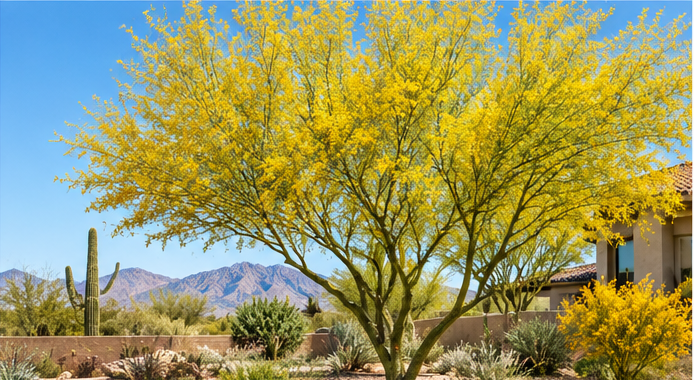
The most recommended tree for Scottsdale residential yards. This is a thornless hybrid of three native palo verde species. It is far safer near walkways and patios than the standard blue or foothill palo verde. It produces a bright yellow flower flush in spring, has green bark that photosynthesizes even when it drops leaves during extreme heat, and reaches 20 to 30 feet at maturity. Its open, airy canopy filters light rather than blocking it completely, which suits most Scottsdale yards better than dense shade trees.
One practical note: the Desert Museum variety is propagated from cuttings, not seed, so make sure you are buying a grafted or cutting-grown specimen from a reputable nursery. Seed-grown trees labeled as “desert museum” are often not the same plant.
Mesquite (Chilean or Argentine variety)
Mesquite trees provide a denser canopy than palo verde. They are a better choice for substantial afternoon shade on a west-facing patio in McCormick Ranch. Chilean and Argentine mesquites are the varieties most commonly used in residential Scottsdale landscapes. They grow quickly, tolerate caliche better than most trees, and produce feathery foliage that softens a yard visually. The main tradeoff is seed pods. They drop throughout the year and require cleanup around paved surfaces.
Desert Willow (Chilopsis linearis)
Often overlooked in favor of palo verde, the desert willow is one of the most beautiful flowering trees for a Scottsdale yard. It produces tubular blooms in pink, purple, and white from late spring through fall. It attracts hummingbirds and stays compact at 15 to 25 feet. It handles caliche reasonably well and needs very little water once roots are established.
Cactus
Cactus are the most structurally durable plants in the Sonoran Desert. In a Scottsdale yard, they serve as long-term anchors. structural elements that define the look of a space for decades.
Saguaro (Carnegiea gigantea)
The saguaro is the defining image of the Sonoran Desert and performs well in Scottsdale yards, but there are two things worth knowing before planting one. First, it grows roughly one inch per year for the first eight years of its life. A two-foot specimen from a nursery is approximately 15 years old. Second, moving a saguaro from the wild or from another property requires a permit from the Arizona Department of Agriculture (azda.gov). As of 2026, this runs approximately $15 in total fees. Buying from a licensed nursery sidesteps this entirely.
Young saguaros need some protection from afternoon sun and frost during their first two winters. Once established, they need almost no intervention.
Golden Barrel Cactus (Echinocactus grusonii)
A reliable focal point for beds, entry areas, and boulder groupings. The spherical shape and golden spines provide year-round visual interest. These plants handle reflected heat from walls and driveways better than most. They grow slowly, reaching about two to three feet across over many years, and cluster over time. Drainage matters. Golden barrels planted in compacted caliche without proper preparation tend to rot at the base, which is the most common reason they fail.
Prickly Pear (Opuntia species)
Prickly pear is one of the most cold- and heat-tolerant plants in this list, which is why it appears naturally across Scottsdale’s open desert areas. The flat pads add a sculptural quality and the fruit attracts wildlife. Engelmann prickly pear is the native species most commonly used in residential landscapes. Give it room. It spreads over time and the spines make it difficult to manage in tight spaces.
Agave and Succulent-Type Plants
Agaves and their relatives add strong architectural form and are among the most genuinely low-maintenance plants available for a Scottsdale yard. They also appear on virtually every HOA approved plant list in the area.
Agave americana (Century Plant)
The largest of the common residential agaves, reaching six to ten feet across at maturity. It produces a dramatic bloom stalk, sometimes 20 to 30 feet tall, once in its lifetime. After that the main plant dies but produces offsets around the base. Plant it with space, away from walkways and high-traffic areas.
Parry’s Agave (Agave parryi)
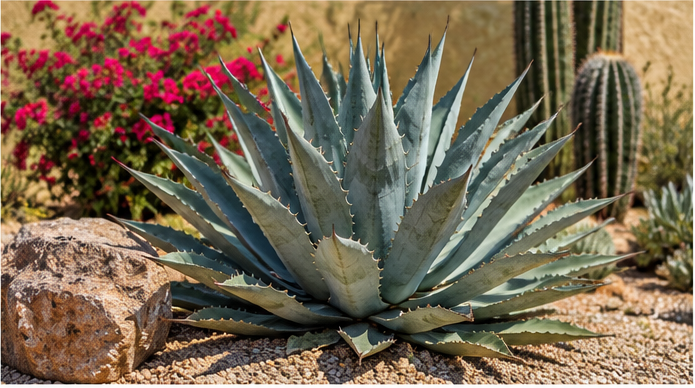
A more manageable size than americana. typically two to three feet across. with a structured blue-gray rosette that works well in modern and transitional landscape styles. It handles cold better than most agaves, which matters on higher lots in North Scottsdale where winter temperatures occasionally drop into the high teens.
Desert Spoon (Dasylirion wheeleri)
Technically not an agave but closely related. The desert spoon has narrow, spiky leaves that form a dense symmetrical rosette, usually two to three feet tall with a similar spread. It holds its structure well in heat and is one of the better choices for HOA communities that require a specific look, since it stays compact and predictable.
Red Yucca (Hesperaloe parviflora)
Despite the name, red yucca is botanically closer to agave than yucca, which means no sharp leaf tips. an important practical consideration near walkways, pool areas, and anywhere children play. The ‘Brakelights’ variety produces a true red flower rather than the standard coral-pink and stays compact at about two feet tall. It blooms from spring through fall and is one of the most reliable hummingbird plants in a Scottsdale yard.
Flowering Shrubs and Perennials
These plants provide the seasonal color that separates a well-designed desert yard from a plain gravel lot. Most perform best when planted in fall (October through November) so they can establish roots before summer.
Texas Sage (Leucophyllum frutescens)
Also called Texas ranger or cenizo, this shrub blooms in response to monsoon humidity, often overnight after a good summer rain. Purple flowers on silver-gray foliage are visually striking. The bloom coincides with the period when most other desert plants look their least interesting. It grows four to six feet tall, handles reflected heat well, and requires almost no supplemental water once established. The main mistake with Texas sage is overwatering. Too much water produces excessive growth that requires constant shearing. Plant it dry and let it do its thing.
Brittlebush (Encelia farinosa)
A native Sonoran Desert shrub that covers hillsides across Scottsdale’s open space with yellow flowers every spring. In a yard, brittlebush works well as a mass planting, along walls, or in large open beds. It grows two to three feet tall, handles poor soil and caliche reasonably well, and blooms heavily from February through April. It goes partially dormant in summer and can look ragged in August. plan your planting layout so something else carries the visual weight through the hottest months.
Desert Marigold (Baileya multiradiata)
A low, spreading perennial that blooms yellow from spring through fall with very little input. It reseeds on its own, which means it fills in over time without replanting. In a Scottsdale yard, it works best as ground cover between larger shrubs or at the front edge of a bed. Bees and butterflies use it heavily during bloom season.
Fairy Duster (Calliandra eriophylla)
A native shrub that produces soft pink powder-puff flowers in early spring. It stays small. typically two to three feet. and works well in combination with blue-gray plants like agave or desert spoon, where the color and texture contrast is particularly effective. Low water needs and good caliche tolerance make it a practical choice for most Scottsdale lots.
Ground Cover
Ground cover in a Scottsdale yard is not just about filling space. it is about suppressing weeds, managing soil temperature, and connecting larger plants visually.
Trailing Lantana (Lantana montevidensis)
Spreads low and wide, covers bare soil quickly, and blooms lavender-purple from spring through fall. It handles reflected heat from walls and hardscape better than almost any other ground cover, which makes it ideal along south and west-facing walls in Scottsdale yards. It is technically a perennial here. it may die back in a cold winter but regrows from the base in spring.
Desert Marigold (as ground cover)
See above. When planted in groups of five or more, it functions as ground cover as much as a flowering perennial.
Decomposed Granite (as a complement)
Not a plant, but worth mentioning. Decomposed granite is the most common ground cover in Scottsdale landscapes. It suppresses weeds, reduces soil moisture loss, and reads as ground cover visually when paired with the right plant palette. Use three-inch depth minimum for effective weed suppression. Under large trees with surface roots, use coarser rock rather than fine DG, which can compact and affect drainage over time.
Plants to Think Carefully About
A few commonly available plants look attractive in a nursery but create problems in Scottsdale yards specifically.
Oleander is widely planted in the Phoenix area but worth reconsidering near family spaces. it is toxic to humans and animals if ingested, and many HOA communities in North Scottsdale and DC Ranch have removed it from their approved lists.
Non-native palms (especially Queen Palms) struggle in Scottsdale’s alkaline soil and often develop manganese deficiency, which shows up as yellowing fronds. They require consistent fertilization and never really look healthy without it. If you want a palm in a Scottsdale yard, Mexican fan palms or date palms handle the soil chemistry significantly better.
Invasive buffelgrass is not sold commercially but spreads from open desert into adjacent yards. It is listed as a noxious weed by the State of Arizona and poses a serious wildfire risk in areas near the McDowell Sonoran Preserve. If you see it coming in along a fence line, remove it early. it establishes fast and is difficult to eradicate once it spreads.
HOA Considerations
Most master-planned communities in Scottsdale. including DC Ranch, Gainey Ranch, Grayhawk, Kierland, and McDowell Mountain Ranch. require architectural committee approval before planting changes in front yards. Many of these communities maintain their own approved plant lists that reference or supplement the AMWUA guide.
The AMWUA Landscape Plants for the Arizona Desert guide is developed in cooperation with the Arizona Department of Water Resources and is widely referenced by municipal and HOA landscape regulations across the Phoenix area, including Scottsdale.
Before finalizing any plant selection for a front yard in an HOA community, confirm the current approved list with your HOA directly. Lists are updated periodically and online versions are not always current.
Choosing Plants for Your Specific Yard
The plants in this guide all perform well in Scottsdale generally, but a few site-specific factors matter more than species selection.
Sun exposure is the most important variable. A west-facing bed in Scottsdale gets intense afternoon sun and radiated heat from hardscape throughout summer. The same plant that thrives in a north-facing bed may decline in the same yard on a different wall.
Caliche depth determines what you can actually plant. Shallow caliche, six to twelve inches below the surface, needs to be broken through in each planting hole before installation. Otherwise the planting area becomes a bowl that collects water and drowns roots. Desert natives like palo verde and mesquite handle shallow caliche better than most plants because their root systems have evolved to work around it. The University of Arizona Cooperative Extension notes that Phoenix-area lots may contain compacted construction soil, caliche, imported fill, or uneven drainage patterns that require attention before planting.
Mature size is consistently underestimated at the nursery stage. A golden barrel cactus in a four-inch pot will eventually cluster to several feet across. A palo verde that looks manageable at planting reaches 25 to 30 feet in 15 years. Plan around mature sizes, not current sizes.
Frequently Asked Questions
The Desert Museum palo verde is the most practical choice for most residential yards. thornless, fast-growing relative to most desert trees, and well-suited to Scottsdale’s soil. For denser shade on a west-facing patio, Chilean or Argentine mesquite provides a fuller canopy.
If you are buying from a licensed nursery, no additional permit is needed on your end. If you are moving a saguaro from the wild or from another property, a permit is required from the Arizona Department of Agriculture (azda.gov). As of 2026, this runs approximately $15 in total fees. Verify current requirements directly with them before any saguaro relocation.
Most HOA communities in Scottsdale reference the AMWUA Landscape Plants guide or maintain their own approved list derived from it. Palo verde, mesquite, agave, desert spoon, Texas sage, brittlebush, and red yucca appear on virtually every list. Confirm current requirements with your HOA before purchasing plants, since lists are updated and online versions may be out of date.
October through March is the recommended planting window. Fall-planted desert perennials and shrubs establish root systems during mild weather and are strong enough to handle their first full summer. Planting between June and August puts new plants under maximum heat stress before roots have established, which increases failure rates significantly.
Putting together a plant plan for your Scottsdale yard? We can walk the property, assess caliche depth and sun exposure, and put together a species list built around your actual conditions. Call or text (602) 737-0504 or visit our xeriscaping service page to learn more about plant selection and desert landscape design. You can also see our lawn care services if you are managing a mix of turf and desert planting.
One Response