
Monsoon Season Landscaping in Scottsdale — How to Prepare Your Yard (2026)
Arizona’s monsoon season runs officially from June 15 through September 30, and storm activity typically peaks in July and August. According to the National Weather Service, monsoon thunderstorms produce roughly half of the annual precipitation for central and northern Arizona. The 2026 season is tracking wetter than normal, with NOAA forecasting a 33 to 50 percent chance of above-normal rainfall statewide.
For Scottsdale homeowners, that means one thing practically: whatever drainage or grading problem your yard has been quietly tolerating will show itself this summer. This guide covers what to fix before the storms arrive, what to watch for during the season, and what to do after a big storm passes through your neighborhood.
What Monsoon Storms Do to a Scottsdale Yard
A monsoon storm here is not like a normal summer rainstorm in most of the country. A typical event arrives fast, dumps significant rain in a short window, and is gone within an hour. Microburst winds of 60 to 100 miles per hour are common within the storm cell. That combination of sudden heavy rain and high wind creates a specific set of problems for landscaped yards.
Soil erosion and gravel scatter. Decomposed granite and loose rock shift during high runoff. Low spots fill with sediment. Gravel that was level in May can pile against walls or wash into the street after a single storm.
Drainage failure. Any low point without proper grading becomes a temporary pond after heavy rain. In caliche soil, water that cannot drain through the hardpan sits on the surface and has nowhere to go.
Plant stress and root exposure. Fast-moving surface water undercuts plants along edges and slopes. Shallow-rooted specimens can shift or topple when saturated soil loses its grip.
Tree and large shrub damage. Microbursts snap brittle branches and can topple shallow-rooted trees, particularly older mesquites and non-native palms without deep root systems. Palo verde branches are more flexible and generally handle wind better, but large trees with heavy canopies on slopes are vulnerable.
Drainage Is the First Thing to Fix
Most monsoon yard damage is a drainage problem, not a rain problem. A yard that moves water away from the house correctly handles most storms without issue.
Check how water moves across your property. Run a hose on the soil near your foundation for 10 minutes. Water should move away from the house toward the yard edge or into a defined channel. If it pools near the foundation, that is a grading problem worth fixing before June.
Clear debris from swales and drainage channels. Dry swales fill with leaves, seed pods, and gravel over winter and spring. A clogged swale cannot move water during a storm. Walk your property and clear anything blocking drainage paths before monsoon begins.
Check downspout outlets. Each outlet should direct roof runoff at least three feet away from the foundation and toward a permeable surface, not onto compacted hardscape where it will pool.
Address low spots near the foundation. Ground that slopes even slightly toward the house becomes a real problem in a storm that drops an inch of rain in 45 minutes.
Plants That Handle Monsoon Well
Most established Sonoran Desert natives are built for the wet-and-dry cycle the monsoon delivers. See our best desert plants for Scottsdale yards for species that hold up well through both heat and heavy rain.
Texas sage blooms in direct response to monsoon humidity, often producing flowers overnight after a significant rain. Its compact root structure does not destabilize in wet soil.
Palo verde trees handle the storms well once established. Their open canopy reduces wind resistance, which is why they fare better in microbursts than trees with dense foliage.
Agave and desert spoon are effectively impervious to heavy rain. Their root systems anchor soil during runoff events and their waxy surface sheds moisture without absorbing it.
Brittlebush and desert marigold go through active late-season growth during and after monsoon. They help stabilize soil on slopes and in open beds.
Plants That Struggle After Heavy Rain
Not everything in a Scottsdale yard handles the monsoon well.
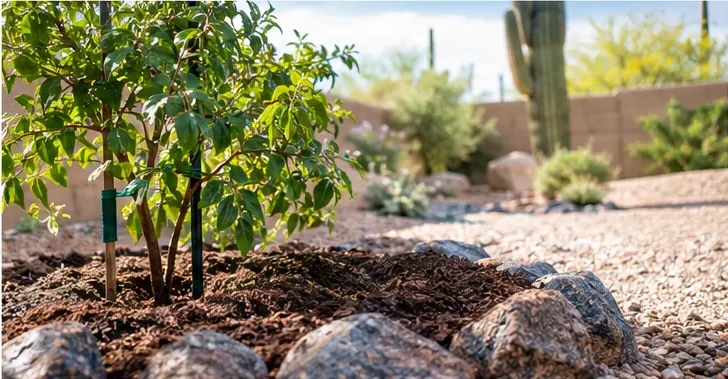
Newly installed plants of any species are the most vulnerable. A tree planted in March has had only a few months to establish roots before the first storm hits. Young specimens can heave out of saturated soil or tip in a microburst. Staking new trees through the first monsoon season is not optional.
Non-native palms, particularly Queen Palms, are vulnerable to root rot in poorly draining soil. A wet monsoon season in a yard without good drainage can kill a Queen Palm that looked healthy all spring.
Golden barrel cactus in compacted or poorly draining soil can develop base rot after extended wet periods. If your barrels sit in a depression where water pools after rain, address the drainage before Jun
Grading, Swales, and Dry River Beds
These three elements do the same basic job: control where water goes when it arrives faster than the soil can absorb it.
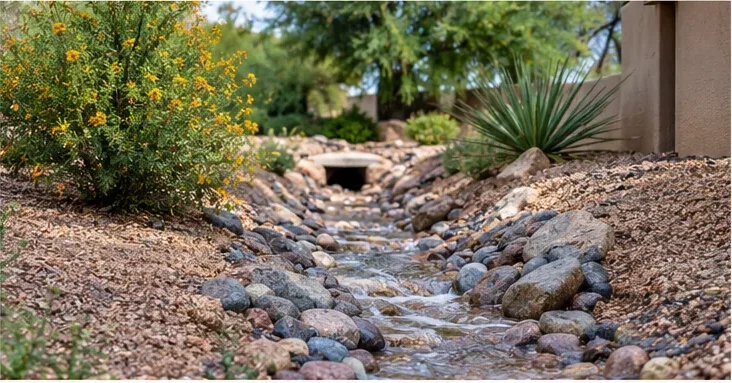
A swale is a shallow, graded channel that moves water across a yard toward a defined outlet. In a properly designed Scottsdale yard, every section drains toward a swale, and every swale leads somewhere water can go without causing damage.
Riprap swales, which are lined with larger rock rather than smooth gravel, slow water velocity and reduce erosion. They are particularly useful on slopes and along fence lines where fast-moving runoff can undermine fence posts over time.
If your yard lacks defined drainage channels and water moves in unpredictable directions after a storm, swale installation before next monsoon is worth considering as part of a broader desert landscape design. Getting slope angles wrong makes drainage worse rather than better, so this is not a project to estimate by eye.
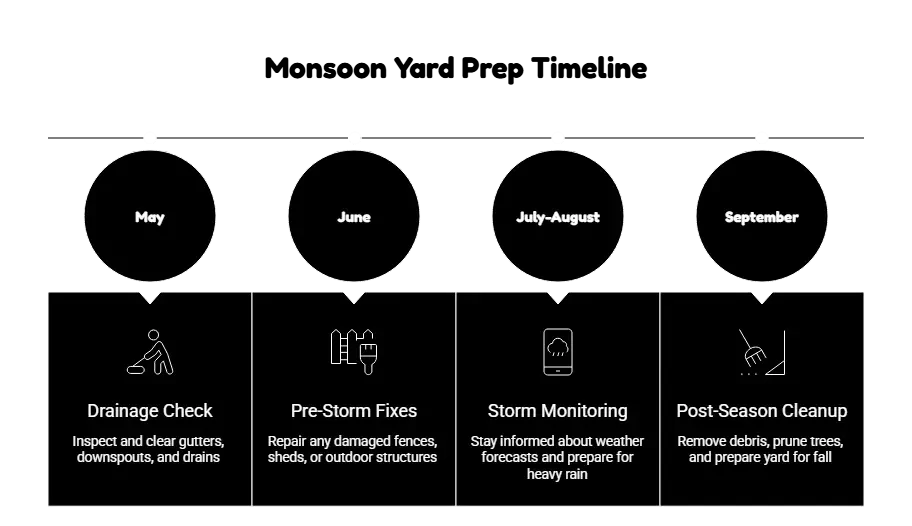
Monsoon Prep Timeline
| When | What to Do |
|---|---|
| April | Inspect drainage channels, clear winter debris from swales |
| May | Re-grade low spots near foundation, stake new trees |
| Early June | Final swale clearance, check downspout outlets |
| June 15 | Monsoon season begins officially |
| July to August | Peak storm activity — stay inside during microbursts |
| After each storm | Run the post-storm checklist below |
| October | Assess erosion, plan drainage fixes |
| October to March | Best window to install improvements and replant eroded areas |
Post-Storm Cleanup Checklist
Run through this after any significant storm. If storm debris is more than you want to clear yourself, our leaf removal service can handle cleanup after a major monsoon event.
- Walk the perimeter and check for erosion along fence lines and bed edges
- Clear gravel or debris washed onto driveways, walkways, or the street
- Check staked trees for lean or movement and re-stake if needed
- Look for water pooling in beds that has not drained within 24 hours
- Check downspout outlets for blockages
- Inspect retaining walls for soil movement or cracking behind the face
- Look at the base of cactus and succulents for softening or discoloration, an early sign of rot after sustained wet conditions
- Document any damage with photos before making repairs, particularly for insurance claims
Standard Arizona homeowners policies cover wind and wind-driven rain. Surface flooding from a wash or lateral runoff typically requires a separate National Flood Insurance Program policy.
Frequently Asked Questions
une 15 through September 30, per the National Weather Service Phoenix office. Peak activity typically falls in July and August when moisture flow from the Gulf of California is strongest.
Scottsdale receives about 7.66 inches of rain annually. A large share of that falls during the June through September window. Individual storms can deliver one to two inches in under an hour, faster than even prepared drainage systems can move water.
Yes, if the tree was planted within the last 12 to 18 months. Established trees handle monsoon winds without staking. Newly installed specimens should be staked through at least the first full monsoon season.
The McDowell Mountains funnel runoff onto lower-elevation properties during heavy storms. Properties near the McDowell Sonoran Preserve and McDowell Mountain Park receive water from a much larger catchment area than their own lot. Grading for these properties needs to account for that upstream contribution, not just on-site rainfall.
Concerned about drainage before the next storm season? We can assess how your property handles runoff and identify any grading or swale issues worth addressing. Call or text (602) 737-0504 or visit our leaf removal page for more on what we cover after a storm. You can also read our xeriscaping guide for plant choices that hold up well through monsoon.