
Caliche Soil in Scottsdale, AZ — What It Is and How to Deal With It
If you have ever tried to dig more than a foot into a Scottsdale yard and hit what felt like concrete, you found caliche. It is one of the most common soil challenges in this part of Arizona, and it causes problems that range from annoying to genuinely expensive if a landscaping project does not account for it upfront.
This guide covers what caliche actually is, why it forms here specifically, what it does to plants and drainage, and the practical options for managing it before installing anything in the ground.
What Is Caliche?
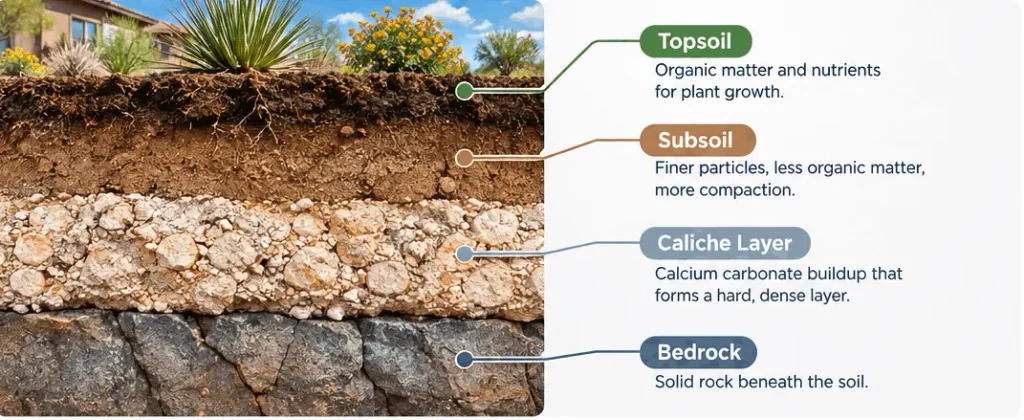
Caliche is a layer of soil in which calcium carbonate has accumulated and hardened over time, cementing soil particles, gravel, and rock fragments into a pale, dense layer that water and roots cannot pass through. The University of Arizona Cooperative Extension, in its publication Managing Caliche in the Home Yard (AZ1281), describes it as a common problem in southern Arizona soils that can appear anywhere from a few inches below the surface to several feet down.
The layer varies in thickness from a few inches to more than six feet in some locations. It can look like light-colored concretions scattered through the soil, or it can form a continuous solid barrier across an entire planting area. Appearance and hardness vary by location, which is why two lots on the same street can have very different conditions.

Why Does Scottsdale Have So Much of It?
Caliche forms in arid and semi-arid regions where rainfall is limited. Scottsdale receives roughly eight inches of rain per year on average. When rain falls, it carries calcium carbonate downward through the soil. In a wetter climate, that calcium keeps moving deeper and eventually leaches away. In a dry climate, the water does not travel far enough, so calcium accumulates at the depth where movement stops. Over hundreds and thousands of years, it concentrates and cements.
This is why caliche is found throughout the Sonoran Desert and why almost every residential lot in Scottsdale has some amount of it. Depth and thickness vary by location, soil type, and how much natural water movement has occurred on that specific site over time.
What Caliche Does to Plants
Two main problems: root restriction and drainage failure.
Root restriction. Most plant roots cannot penetrate a solid caliche layer. They spread laterally when they hit it, which limits how deep and how stable a plant can anchor itself. Trees planted in soil with shallow caliche often become unstable as they grow, particularly in high-wind conditions like the monsoon microbursts common in Scottsdale. Shallow roots also mean the plant has access to a smaller volume of soil and nutrients.
Drainage failure. Water cannot pass through a continuous caliche layer any more than roots can. During irrigation or after a monsoon storm, water accumulates above the layer and sits there. This creates waterlogged conditions directly above what is often dry, hard ground. Many desert plants that handle drought well are intolerant of prolonged root saturation. Standing water above caliche is one of the most common reasons plants fail in Scottsdale yards even when watering appears correct.
The University of Arizona Cooperative Extension notes that caliche can reduce soil pH and affect iron availability, which is why plants in caliche-affected soil sometimes show yellowing leaves even with adequate fertilization.
How to Check Your Yard for Caliche
No special equipment needed for a basic check.
The screwdriver test. Push a long screwdriver or metal rod into the ground after watering. If it stops at a consistent depth across multiple spots, you have found the top of a caliche layer. Where it stops is where the layer begins.
The drainage test. Dig a hole about a foot across and 18 inches deep. Fill it with water and time how long it takes to drain. Per University of Arizona Cooperative Extension guidance, water that does not drain within a few hours indicates a drainage problem caused by caliche or heavy compaction below the hole.
On-site probing. When assessing a property before a landscaping quote, checking for caliche in proposed planting zones is one of the first steps. Depth and thickness at each planting location affects both the approach and the cost of the project.
Managing Caliche — Your Practical Options
The best approach depends on caliche depth, thickness, what you are planting, and your budget.
Break Through It
For planting holes, the most effective approach is breaking through the layer entirely so roots and water have a clear path below it. Depending on thickness and hardness, this means a heavy-duty digging bar, a rented electric jackhammer, or in severe cases, a pneumatic jackhammer. For thick, continuous caliche, power equipment is not optional. Hand tools are ineffective and will be damaged in the attempt.
Once broken through, remove the chunks from the planting hole.
Drill a Drainage Chimney
Where breaking through the full layer is not practical, the UA Extension recommends drilling a narrower drainage chimney through it and filling with gravel. This gives water a path to escape while minimizing excavation. It works reasonably well for individual planting holes but does not address drainage across a broader area.
Add Soil Above the Layer
Where penetrating caliche is not feasible, adding soil above it is an option. The UA Extension is specific about depth: sufficient soil should be added to provide at least two feet of total depth over the entire rooting zone. For a mature tree, the rooting zone extends one and a half to four times the canopy width. This can mean significant amounts of imported soil and raised planting areas, not just a few inches of topdressing.
This approach only works if drainage is also addressed. Adding two feet of soil above an impermeable layer without a drainage solution creates a deeper version of the same problem.
Choose Plants That Tolerate Shallow Soil
Some plants handle caliche better because their root systems spread laterally rather than requiring deep penetration. Palo verde, mesquite, agave, prickly pear, and most native desert shrubs have evolved in caliche-prone soil and manage it better than non-native species that expect deep, well-drained conditions. This is one reason plant selection in Scottsdale yards matters more than in most other regions.
Caliche and Irrigation
Caliche affects irrigation design in ways that are easy to overlook. A drip system calibrated on normal soil absorption rates will over-water plants in a caliche-affected yard, because water that cannot drain sits in the root zone longer than expected.
If plants show signs of both drought stress and overwatering — wilting combined with yellowing, or soft spots at the base of cacti — the root zone may be saturated above a caliche layer while appearing dry at the surface. Checking soil moisture below the surface before watering is more reliable than going by appearance alone. Our irrigation service can help diagnose and adjust systems for properties where caliche is affecting drainage.
Caliche and Construction
Caliche affects more than planting. Pool excavation, fence post installation, irrigation line trenching, and any below-grade construction in Scottsdale encounters caliche on most lots. Projects priced on standard soil assumptions can go over budget when dense caliche appears mid-excavation. This is why investigating soil conditions before finalizing quotes on any project that involves digging is standard practice for experienced local contractors.
Before and After Proper Caliche Management
| Without Management | With Proper Management |
|---|---|
| Water pools above caliche after irrigation | Water drains through broken layer or chimney |
| Roots spread laterally, trees become unstable | Roots penetrate below layer, better anchoring |
| Plants show yellowing and iron deficiency | Soil pH and nutrient access improve |
| Monsoon runoff has nowhere to go | Drainage channels function correctly |
| Plant failure despite correct watering schedule | Plants establish and perform as expected |
concerned about caliche on your property before a landscaping project? We probe for it during every on-site visit and account for it before giving a quote. Call or text (602) 737-0504, or read our xeriscaping guide for plant choices that handle Scottsdale soil conditions well. For site prep before installation, see our lawn mowing.
Frequently Asked Questions
Most do, but depth and thickness vary significantly from lot to lot and across a single property. Some yards have a thin, porous layer that barely affects drainage. Others have a dense continuous barrier within the first foot of soil. Probing or digging is the only reliable way to know what you have.
For small, shallow-rooted species like groundcovers and small cacti, planting above a caliche layer sometimes works if drainage is adequate. For trees and larger shrubs that need deep roots and consistent drainage, planting without addressing caliche usually results in poor establishment and eventual failure.
It depends on depth, thickness, and extent. Breaking through a few individual planting holes adds modest labor. A continuous layer across a large area requiring power equipment and debris removal adds significantly to total cost. Probing before quoting is the only way to give an accurate number.
Some acidifying treatments can slowly reduce calcium carbonate content over time, but they are not practical for a dense layer before planting. Mechanical removal or drainage chimneys remain the standard approaches for residential landscaping in Scottsdale.
Caliche is found throughout the Sonoran Desert, including Phoenix, Tempe, Mesa, Chandler, and Gilbert. Scottsdale lots, particularly in North Scottsdale near the McDowell Mountains, can have more variable conditions because of the mix of rocky soil and alluvial deposits from mountain runoff.